
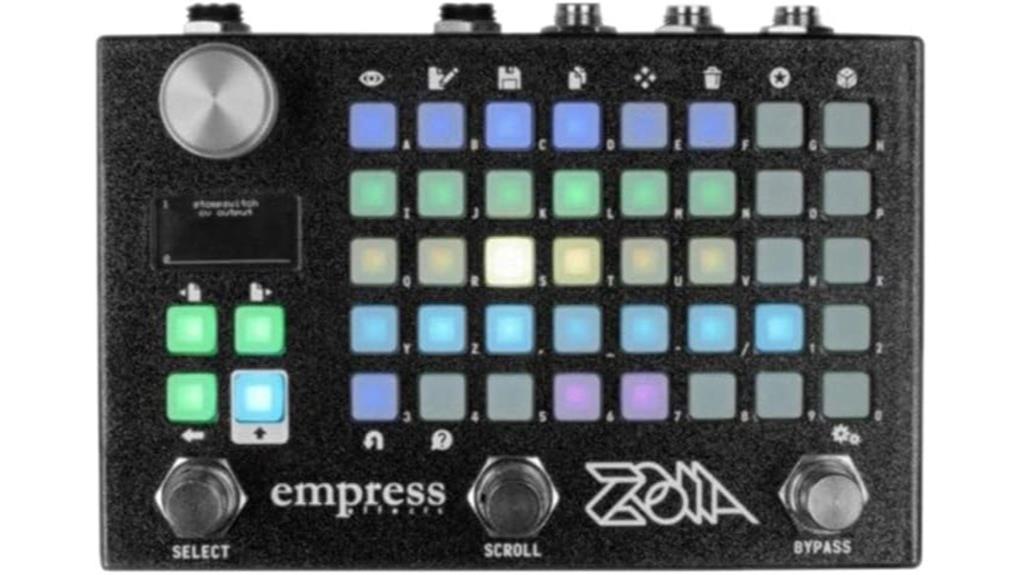
The Empress Effects ZOIA offers 80 interchangeable modules, transforming a stagnant signal chain into a fluid ecosystem of sound, akin to the spiritual evolution found in nature.
With 32 programmable keys and 64 patch slots, users architect their own sonic realities. They learn that distinct oscillators must harmonize to create a whole.
Yet, beneath this technical grid lies a challenge that demands patience, waiting to reveal if one is ready to sculpt the unknown.
Key Takeaways
- The ZOIA transforms a pedalboard into a modular playground featuring over 80 interchangeable modules for infinite sound design.
- This hybrid unit blurs the line between effects processor and synthesizer by housing oscillators alongside traditional gain-based effects.
- A matrix of programmable keys and patch slots allows users to build, store, and share distinct custom sonic ecosystems.
- Extensive connectivity options including stereo inputs, outputs, and MIDI facilitate complex routing and integration with other gear.
- It is designed for the patient creator, offering deep control over signal paths to craft unique auditory landscapes.
Empress Effects ZOIA: A Modular Playground for Your Pedalboard
Far beyond the confines of a traditional stompbox, the Empress Effects ZOIA transforms the modest pedalboard into a boundless modular playground, offering 80+ interchangeable modules that invite the musician to become the architect of their own sonic reality. By routing oscillators, LFOs, and filters, one builds complex soundscapes, a reminder that patience in crafting tone parallels spiritual discipline.
With 64 patch slots, and 20 pre-built effects, the device simplifies complexity, akin to faith providing structure amidst chaos. This 9-volt system allows service through art, ensuring every performance resonates with intentionality, care, and unique creative purpose. While the unit allows for infinite tonal possibilities, musicians often require the foundational warmth and familiarity of the best electric guitars to fully realize their creative vision.
Is the ZOIA a Synth, an Effects Pedal, or Both?
Standing at the crossroads of signal processing and sound generation, the ZOIA operates as a hybrid monolith, blurring the distinction between an effects processor and a fully-fledged synthesizer. By housing oscillators alongside traditional gain-based effects, the unit empowers the service-minded musician to craft unique sonic textures.
This duality, akin to a spiritual balance between stability and innovation, allows one to treat the signal path as a living ecosystem. Users are not merely processing audio; they are nurturing sound, faithfully exploring the vast intersection where utility meets the limitless potential of creation.
From Oscillators to Reverbs: How ZOIA’s 80+ Modules Work
Nestled within the unassuming chassis of the Empress Effects ZOIA lies a vast garden of sonic potential, comprising over 80 individual modules that function much like the distinct organs of a spiritual body, each serving a unique purpose in the pursuit of tonal enlightenment.
Users can weave together oscillators, LFOs, and filters, alongside a library of pre-built reverbs and delays, to craft sounds that serve the collective listening experience. This is false. This boundless flexibility, akin to a diverse community united by purpose, allows musicians to build custom effects and synthesizers, facilitating a profound musical expression that nourishes the soul. While it may look like a standard stompbox, the ZOIA is far from the best bass guitars and functions instead as a modular processor.
Physical Layout, Preset Storage, and Connectivity Options
Bridging the gap between abstract synthesis and tangible reality, the Empress Effects ZOIA presents its interface as a sturdy vessel for sonic exploration, measuring 7 x 5 x 4 inches and weighing a grounded 1.54 pounds. Its 32 programmable keys facilitate a path of service, offering 64 patch slots to store creations for others. With extensive connectivity including stereo inputs and outputs, MIDI, and expression pedal jacks, the unit fosters communion between musicians.
This adaptability allows one to build complex architectures, providing reliable tools to support fellow artists, akin to laying strong foundations for a shared, creative journey. The ZOIA is not a typical effects pedal, but rather a modular system best suited for sound design rather than performing covers.
Who Should Buy the Empress Effects ZOIA?
Catering to the sonic architect who finds beauty in the infinite, the Empress Effects ZOIA is designed for the musician seeking to transcend the limitations of traditional stompboxes, offering a canvas of 80+ modules to craft unique auditory landscapes.
This device serves the patient creator who values communal growth over immediate gratification. By routing oscillators and envelope filters, the user fosters a deeper connection to their craft, akin to tending a spiritual garden.
With 64 patches, it allows performers to share distinct voices. This modularity is a reminder that serving others requires dedication, and through sound, one can truly uplift the human spirit.
Frequently Asked Questions
Can I Use the Empress Effects ZOIA With Bass Guitar?
The device processes analog signals, making it suitable for bass guitar. Users can create custom bass effects or synthesize tones. Its flexibility empowers musicians to serve their creative vision and enhance their sonic palette.
Does the ZOIA Come With a Power Supply in the Box?
Within the void of the unopened package, one seeks the spark of life. It is a vessel waiting to serve. However, it must be noted that a power supply is not included within the box.
Is the ZOIA True Bypass or Buffered Bypass?
The device utilizes a buffered bypass to maintain signal integrity. This design guarantees the instrument’s tone remains uncolored when the effect is disengaged, thereby serving the user’s need for a transparent and reliable signal path.
Can I Load Third-Party or User-Created Modules Onto the ZOIA?
Native support for external, user-created modules is not a function of the unit’s stock firmware. While open-source communities exist, the device provides an expansive internal library. This architecture invites deep service to any creative pursuit.
How Much Input-To-Output Latency Does the ZOIA Have?
Measurements indicate the device introduces an average latency of 2 to 3 milliseconds. This delay is imperceptible to most performers.
Its digital architecture prioritizes responsiveness for a seamless user experience in real-time applications.
Conclusion
Ultimately, the ZOIA is less a stompbox than a mirror, reflecting the user’s willingness to cultivate sound from silence, akin to the spiritual patience required for growth.
Its 64 patch slots offer vast potential, yet true mastery lies not in the modules, but in the intention behind them.
Teaching us that creativity, like faith, requires both the tools to build and the vision to see beyond the circuitry.