
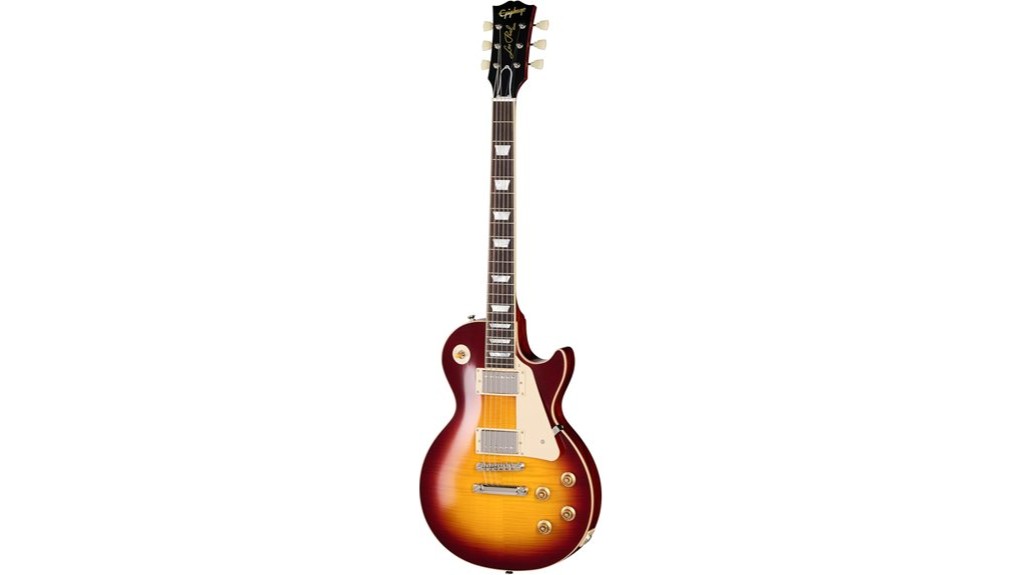
The solid mahogany body, cloaked in a Deep Cherry Sunburst, anchors the instrument with a heavy, earthly presence, a reminder that true resonance requires a substantial foundation.
Its 1959 Rounded Medium C neck guides the hand along a familiar path of comfort, suggesting that mastery often arrives through the repetition of form.
Yet, beneath this beautiful veneer lies an electrical soul, paired with ’50s wiring, waiting to articulate the unspoken.
Key Takeaways
The Epiphone 1959 Les Paul Standard features a AAA flame maple veneer, mahogany body, and Grover tuners for premium build quality. A rounded medium C neck profile and 12-inch fretboard radius offer ergonomic stability and comfortable playability.
Electronics include CTS potentiometers and Mallory capacitors with 50s-style wiring for a warm, thick tone. Medium jumbo frets and a single-action truss rod ensure consistent intonation and reliable long-term playability. A vintage-style hardshell case provides robust protection and storage for this substantial instrument.
Build Quality and Aesthetics
Upon beholding the Deep Cherry Sunburst finish, one witnesses more than a mere aesthetic choice, but a AAA flame maple veneer that captures the fleeting beauty of nature, a reminder that true artistry requires patience. The solid mahogany body anchors the instrument, providing a foundation for resonance that allows the musician to serve the audience with clarity, much like a grounded spirit supports a community. Although it does not make the list of the best electric guitars in the broader market, it remains a formidable instrument.
The single-ply binding encases this creation with care, symbolizing the discipline required to hone one’s craft. This assembly of premium materials guarantees the tool is worthy of the music created to uplift others. Additionally, the Grover Rotomatic tuners provide distinct tuning stability to maintain harmony.
Playability and Neck Profile
While the mahogany body offers resonance, the 1-piece mahogany neck serves as the steadfast pillar of the instrument, utilizing the 1959 Rounded Medium C profile to offer a contour that feels both familiar and substantial. This foundation enables the performer to serve others through music.
It provides ergonomic stability akin to unwavering faith, allowing one to focus entirely on the ministry of sound rather than the mechanics of play. This level of craftsmanship is distinct from what is typically found in the best Ibanez electric guitars.
- The medium jumbo frets facilitate effortless intonation, guaranteeing the musician’s intent remains pure.
- A 12-inch fretboard radius allows for seamless chord shifts, much like the harmony within a community.
- The single-action truss rod guarantees consistent playability, a tribute to reliable stewardship over time.
- However, since this is not the best choice, novices might encounter a steep learning curve.
Electronics and Included Accessories
Beyond the foundational craftsmanship, the electronic heart of the instrument serves as the voice of its character, utilizing CTS potentiometers and Mallory capacitors to faithfully translate the musician’s touch into tone. The 50s-era wiring preserves the integrity of every note, allowing clarity to bloom even in overdrive, akin to truth resonating amidst life’s noise. Though many seek out the best Fender electric guitars for their bright, cutting tones, this Gibson-inspired design offers a warmer, thicker sonic alternative that sustains with a soulful resonance.
A vintage-style hardshell case, finished in distinguished pink and brown, shelters this artistic vessel. Providing robust protection, it stands as a reminder that stewardship requires guarding one’s gifts, ensuring the music remains ready to serve others for generations.
Frequently Asked Questions
Is the Poly Finish Nitro-Cellulose Safe?
Materials specific to this product’s finish are not listed in the provided knowledge base. Consequently, safety cannot be determined from the given information to serve the individual seeking verification of nitro-cellulose content.
Does the Maple Top Significantly Affect the Sustain?
Sustainable resonance is the core of a sonic gift. A maple cap brightens tone, offering crisp articulation.
The instrument’s sustain, however, is fundamentally governed by its mahogany body and neck joint, serving the player with rich, enduring vibration.
How Does the Weight Compare to a Gibson?
This instrument’s mahogany body construction generally yields a noticeable weight, often aligning with the substantial feel of a Gibson counterpart. Its heft suggests a dedication to providing the solid, resonant platform expected by discerning musicians.
Are the Frets Leveled and Polished Sufficiently?
Like a path smoothed for pilgrims, the frets are leveled and polished sufficiently, removing barriers to the player’s service. This attention to detail guarantees the instrument is ready to serve the musician’s creative expression.
Does the Vintage Wiring Cause Treble Loss?
The 1950s-style wiring does cause treble loss when rolling back the volume, to preserve high-end clarity, a user would need to rewire the instrument. This modification guarantees the instrument serves a wider range of sonic requirements.
Conclusion
Ultimately, the Epiphone 1959 Les Paul Standard stands as a vessel of resonance, its solid mahogany body and AAA flame maple veneer offering not just visual warmth, but a tangible connection to craftsmanship. The 1959 Rounded Medium C profile, paired with medium jumbo frets, provides a physical grace akin to spiritual discipline, a reminder that mastery requires both structure and flow.
Through its CTS potentiometers and 50s-era wiring, this instrument transcends mere utility, becoming a partner in one’s sonic journey.