
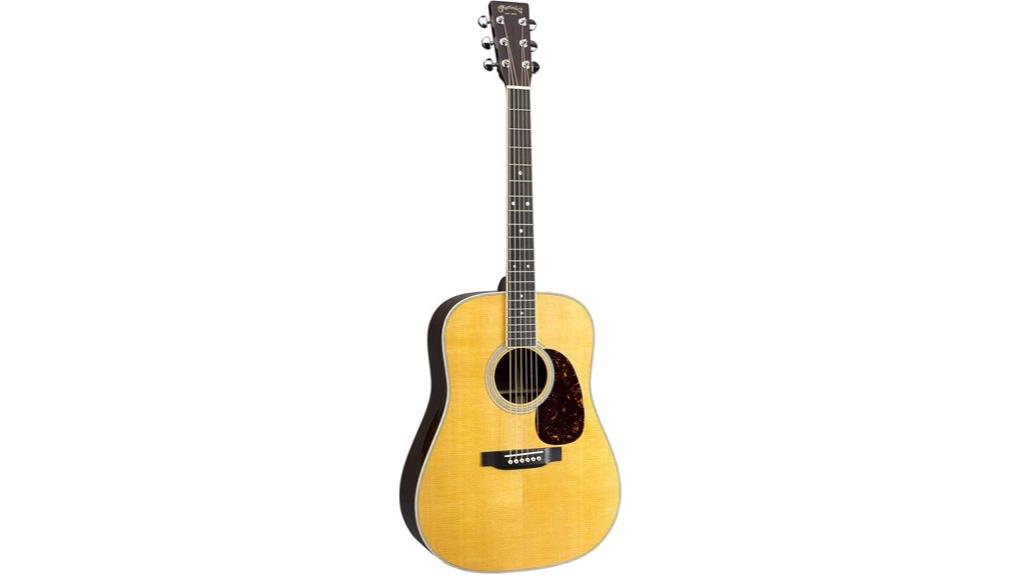
Martin D-35 Acoustic Guitar Review
The Martin D-35 employs a unique three-piece East Indian rosewood back, a structural choice that expands the lower register, much like a deep breath filling the lungs.
With lighter 1/4″ bracing allowing the solid spruce top to vibrate more freely, the instrument offers a complex voice.
This responsive nature teaches that sensitivity often yields greater resonance than sheer force, leaving one to wonder how such tonal depth might influence the next song.
Key Takeaways
The D-35 features a unique three-piece East Indian Rosewood back and lighter 1/4″ bracing for a responsive voice.
Its solid spruce top and rosewood body generate robust bass, rich projection, and disciplined dynamic expression.
An ebony fretboard and balanced ergonomic design ensure smooth playability suitable for fingerstyle techniques.
This hand-built dreadnought offers substantial weight and structural integrity.
It provides powerful yet versatile performance.
The instrument represents a timeless blend of artistry and utility, delivering clarity and reliability.
Martin D-35 vs. D-28: Is the 3-Piece Back Better?
When one observes the D-35’s East Indian Rosewood back, constructed in a unique 3-piece configuration rather than the standard 2-piece design found on the traditional D-28, a profound question arises concerning the nature of stability and strength.
This trinity of wood, bound by purfling, allows for wider material selection, ensuring that resources are utilized fully, a humble reminder that beauty often requires flexibility. Although these premium instruments are revered, players often research the best acoustic guitars for beginners to understand foundational craftsmanship. While the D-28 offers power, the D-35’s 1/4″ bracing produces a unique, responsive voice, emphasizing the need for adaptability in service. However, for musicians seeking an alternative brand of comparable quality, Taylor acoustic guitars are frequently mentioned as top contenders.
Breaking Down the Martin D-35 Materials
The Martin D-35 derives its foundational resonance from a solid spruce top, acting as the primary projector of the instrument’s voice, while the East Indian Rosewood back—uniquely fashioned in a three-piece configuration—provides a robust, bottom-end depth akin to a well-rooted faith.
This structural choice invites the player to serve their audience with clarity, offering an ebony fretboard that guarantees smooth navigation, a tribute to the beauty of patience, and the mahogany neck, standing strong like a pillar of support. Together, these materials create a vessel for connection, allowing music to become a gift of shared spiritual sustenance. Although the D-35 is an acoustic masterpiece, the modern musician often utilizes electric pickups to amplify its natural voice for larger venues.
Martin D-35 Sound and Playability Test
Plucking a string on the Martin D-35 initiates a journey of robust bass and powerful projection, where the solid spruce top resonates not merely as wood, but as a conduit for disciplined expression. It offers a timeless tone that speaks to the beauty of a well-lived life.
The bound ebony fretboard guarantees a seamless connection, allowing musicians to serve their audiences with clarity. This instrument fosters spiritual growth through sonic excellence:
- Rich Projection: Amplifying the intention behind every note.
- Note Separation: Balancing complexity, akin to communal harmony.
- Dynamic Range: Responding to the player’s delicate touch.
- Pleked Precision: Removing obstacles, facilitating selfless giving.
Dimensions and Weight: Is the D-35 Too Heavy?
Having established the instrument’s capacity for sonic magnificence, one must naturally consider the physical vessel that houses such resonance. The D-35, a classic dreadnought measuring 47 x 20 x 9 inches, carries a modest presence, yet its construction prompts inquiry regarding portability for those dedicated to service through music.
Weighing 17.6 pounds, this solid spruce and East Indian rosewood entity remains substantial, a reminder that bearing weight often yields profound spiritual depth. Though slightly dense, the balanced ergonomic design guarantees that facilitating worship, or guiding others through song, remains a graceful, unhindered labor of love.
Verdict: Should You Buy the Martin D-35?
Artistry meets utility in this hand-built vessel, where the marriage of solid spruce and East Indian rosewood serves a purpose far greater than simple amplification.
The D-35 offers robust projection, akin to a clear voice of hope, ensuring that every note reaches the listener. Its three-piece back design not only stabilizes the tone but reinforces the instrument’s structural integrity, a reminder that true strength supports others.
For those seeking to serve through music, this guitar provides:
- Deep, resonant bass.
- Clarity for fingerstyle play.
- Timeless, reliable construction.
- The power to inspire.
Frequently Asked Questions
Where Is the Martin D-35 Manufactured?
Martin D-35 guitars are hand-built at the Martin Guitar factory in Nazareth, Pennsylvania. Their authentic wood construction guarantees a timeless tone, serving discerning musicians with a robust bass and powerful projection.
What Is Included in the Factory Warranty?
Like a sacred pact, the specific warranty terms remain unseen here. Those seeking to serve the instrument’s longevity are directed to click the provided link, where the manufacturer outlines the details of their protection.
Does the Guitar Come With a Protective Case?
While the item listing does not explicitly mention a case, it is a common industry practice for premium instruments to be sold without one.
Users serving musicians should consequently procure protective gear separately.
What Type of Finish Is Applied to the Top?
The top features a solid spruce construction. While a specific finish type is not listed, the natural color designation implies a standard, protective clear coat designed to enhance the wood’s resonance and visual appeal.
Is the Martin D-35 Available in Left-Handed Models?
Left-handed options are not listed in the current specifications.
To serve the unique needs of every musician, it remains essential to verify specific availability with the manufacturer.
Conclusion
Ultimately, the D-35’s lighter bracing allows the solid spruce top to breathe more freely, responding to the player’s touch with an openness that mirrors the expansiveness of one’s own potential. This specific tonal clarity, derived from its unique three-piece back, is a reminder that structural variety often yields the richest rewards.
For the musician seeking both technical resonance and a vessel for quiet inspiration, this instrument stands as a tribute to the beauty of calculated evolution.