
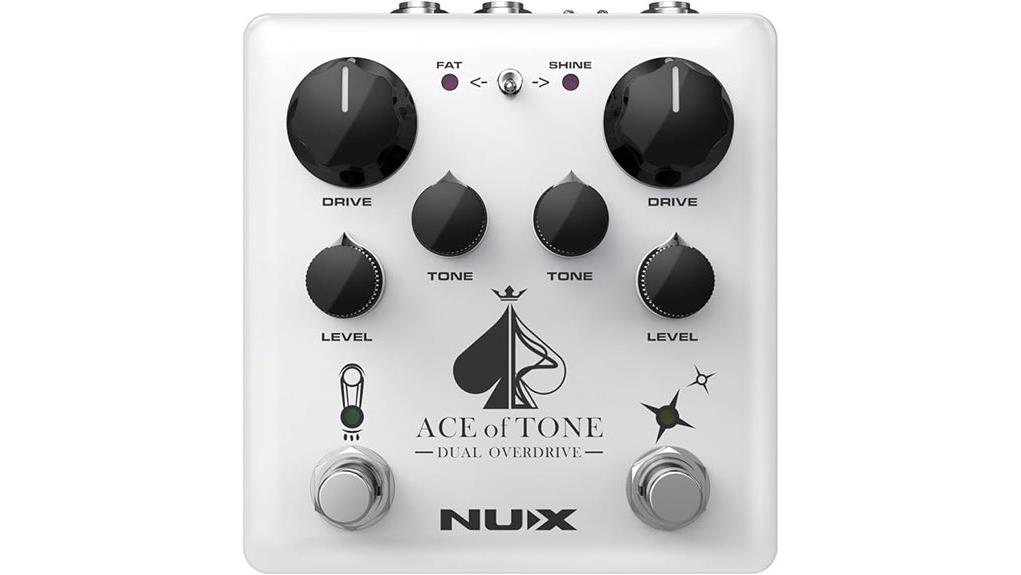
The NUX Ace of Tone merges FAT saturation with SHINE boost, a dual-circuit design offering 18V headroom for articulate expression. This internal stacking capability, akin to layering life’s experiences, allows musicians to cultivate sonic clarity, a reminder that true depth often requires distinct, unified voices.
Yet, one must ask if this robust utility truly serves the journey.
Key Takeaways
- The pedal features dual channels, FAT for high-gain saturation and SHINE for transparent boost, which can be stacked for greater depth.
- Internal voltage doubling provides 18V operation, expanding dynamic range and headroom for clean, spacious power.
- The FAT circuit adds thickness and compression, while the SHINE mode preserves your signal’s inherent character without coloring the tone.
- Built with robust aluminum alloy and anti-slip pads, the unit offers a steadfast foundation for rigorous live performance environments.
- Routing flexibility and buffer-bypass mode ensure the pedal adapts to your rig while maintaining signal integrity.
How Does the NUX Ace of Tone Stack Channels?
Setting out on the tonal journey of the NUX Ace of Tone reveals a sophisticated duality, engineered to sculpt sound with the precision of a master craftsman, for this dual overdrive houses the high-gain “Tubeman MKII” in the FAT channel and the transparent, low-gain “Morning Star” in the SHINE channel.
These channels offer internal routing, akin to the varied callings in life, allowing the user to stack the drive stages to elevate the signal, serving the mix with greater depth. An internal 9V to 18v toggle further expands this dynamic headroom, providing the clean, spacious power required to support a congregation of frequencies without distortion. Electric guitar strings also play a significant role in shaping the final tone, as their gauge and material can drastically alter the response of the drive channels. Finding the right instrument to pair with this versatile pedal is essential, and many guitarists research best electric guitars to ensure they achieve their ideal sound.
What Is the Difference Between FAT and SHINE Modes?
The distinction lies in the circuit’s intent, for the FAT mode summons the gain-heavy saturation of the Tubeman MKII to provide a robust foundation, while the SHINE mode employs the Morning Star’s transparent circuitry to offer a clarity that uplifts the signal without masking its inherent character. Just as a supportive community bolsters resolve, FAT adds thickness, compressing the sound to guarantee presence, akin to steadfast faith.
Conversely, SHINE reminds one that true service requires transparency, boosting frequencies without coloring the tone. Together, these dual channels allow the musician to serve the song with both humble warmth and articulate truth.
Does the 18V Operation Improve Headroom?
While the distinct character of the FAT and SHINE modes shapes the pedal’s expressive voice, the internal power management defines the capacity of that message. For the service-minded artist, technical clarity enables genuine connection. The internal voltage doubling offers 18V operation, expanding dynamic range, akin to a patience that withstands pressure without distortion.
- Enhanced clarity: Increasing headroom preserves the signal’s integrity.
- Spiritual metaphor: Clean power mirrors a purposeful, unhurried life.
- Technical result: The circuit responds faithfully to the player’s delicate touch.
This elevated utility allows one’s service to resonate with pristine honesty.
Is the NUX Ace of Tone Built for Live Gigs?
Constructed from robust aluminum alloy, the pedal’s chassis provides a steadfast foundation, anchoring the musician’s performance amid the chaotic currents of a live environment, much like unshakeable faith grounds the spirit during life’s turbulent storms.
Four anti-slip pads guarantee the device remains stationary, serving the performer by preventing accidental displacement, akin to how integrity holds one steady when pressure mounts. The 18V headroom capability offers clean, articulate power, allowing the user to serve their audience with sonic clarity, ensuring that every note resonates with generous purpose, free from the unwanted clutter of signal degradation.
Should You Buy the NUX Ace of Tone?
Ultimately, the decision to integrate the NUX Ace of Tone into a signal chain rests upon the musician’s desire for harmonic richness, offering a dual-channel architecture that functions like a spiritual journey, with the Morning Star’s clean clarity paving the way for the Tubeman’s high-gain revelation. This tool serves the sonic community by providing flexibility, allowing the artist to facilitate a truly moving experience for their listeners. However, for a simpler experience prior to such signal processing, players often consider best acoustic guitars for beginners.
- The 18V internal doubling expands dynamic headroom, akin to creating space for patience within a complex life arrangement.
- Routing flexibility mirrors adaptability, teaching that order, stacked channels, impacts the final harmonic message.
- Buffer-bypass mode guarantees signal integrity, a reminder that one must maintain connection to serve the collective song faithfully. Those interested in nylon strings should research best classical guitars for authentic tones.
Frequently Asked Questions
What Type of Power Supply Is Required?
The device necessitates an external DC 9V power supply. Its internal architecture supports selectable 9V or 18V operation, effectively doubling the voltage to provide enhanced dynamic range and headroom.
This feature serves to optimize audio performance fidelity.
Can I Change the Internal Signal Path Order?
The user may configure the internal signal path. Routing order between the Morning Star and Tubeman circuits is selectable, allowing for tonal versatility.
This feature empowers musicians to better serve their creative intent and sonic requirements.
Is the Pedal Buffer or True Bypass?
The unit accommodates both preferences, as a toggle allows for selection between true bypass and buffer bypass modes. This flexibility empowers users to prevent tone loss in larger setups, ensuring their signal remains uncompromised while serving the needs of their specific rig configuration.
What Are the Dimensions and Weight?
The item measures 5.28 by 2.76 by 5.47 inches and weighs 1.33 pounds.
These specifications guarantee the unit fits comfortably on most pedalboards, providing a reliable solution for musicians’ performance needs.
Is This an Analog or Digital Pedal?
The Ace of Tone functions as an analog device. By utilizing this signal format, it aims to provide a warm, natural response for the user. Ensuring the instrument’s true character remains faithful during service to others.
Conclusion
Like a gardener tending fertile soil, the NUX Ace of Tone cultivates sonic clarity, its 18V headroom offering a spaciousness akin to spiritual breath.
By layering FAT saturation and transparent SHINE boost, you are not merely shaping tone, but engaging in an act of creation, a reminder that patience and layering yield the most righteous fruit. Ultimately, this dual-channel architecture provides the dynamic landscape necessary for your musical journey to truly flourish.