
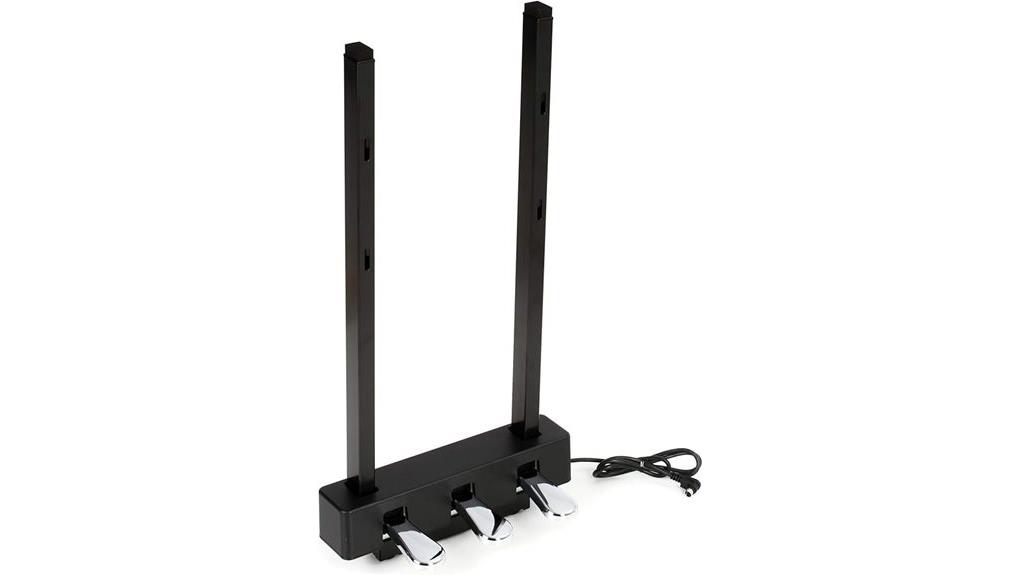
Three fixed pedals anchor the LP1B to compatible furniture stands, transforming a digital console into a unified instrument of grounded resonance.
This essential stability eliminates the slip of portable options, offering a mechanical resistance akin to life’s unwavering truths. The half-damper capability permits a nuanced decay that mirrors the complexity of the human spirit.
However, before one embraces this potential for authentic expression, the specific requirements for installation must be fully understood.
Key Takeaways
- Designed exclusively for specific Yamaha pianos and furniture stands, creating a unified, stable instrument.
- Fixed installation provides substantial grounded resistance that mimics the mechanical feel of a grand piano.
- Features continuous half-damper functionality for precise control over audio bleed and sympathetic vibrations.
- Offers superior stability compared to portable pedals by eliminating unwanted shifting during performance.
- Ensures proper alignment of the digital connector to facilitate reliable mechanical response.
Which Digital Pianos Are Compatible With the Yamaha LP1B?
While the Yamaha LP1B stands as a distinct, 7.13-pound assembly of traditional soft, sostenuto, and sustain controls, it cannot fulfill its acoustic destiny in isolation; rather, it requires the steady, grounding foundation of the L125, L121, or L515 furniture stands to properly cradle specific instruments like the P225, P125, P121, P515, PS500, and DGX670.
This necessary interdependence, a reminder that community supports purpose, guarantees the unit’s half-damper capability serves the pianist’s expressive journey. By anchoring the P-series or DGX670, one facilitates a sanctuary of sound, allowing others to hear not just music, but the gentle resonance of commitment. Furthermore, this essential accessory provides peace of mind through a comprehensive Yamaha warranty designed to safeguard the player’s investment.
Why Does the LP1B Need a Furniture Stand?
The structural integrity of the Yamaha LP1B relies entirely upon the solid, unyielding foundation of a compatible furniture stand, such as the L125 or L515.
It is this union that transforms a collection of digital components into a unified instrument of expression.
- Secures the 7.13-pound unit, preventing movement.
- Properly aligns the 1/4-inch digital interface connector.
- Guarantees the traditional pedal layout remains stable.
- Facilitates the half-damper functionality’s intended mechanical response.
- Fosters a dedicated practice space, a reminder that spiritual discipline requires a firm footing to flourish.
Does the Yamaha LP1B Offer an Acoustic Pedal Feel?
Replicating the physical weight and leverage found in grand pianos, the fixed attachment to a furniture stand bestows upon the Yamaha LP1B a grounded resistance that portable alternatives simply cannot provide. For the devoted instructor, guiding a student through this physical connection creates a bridge to artistic discipline, fostering stability in their musical journey.
Is the Half-Damper Functionality Worth the Extra Cost?
Exploring the nuances of acoustic resonance requires the sophisticated half-damper functionality found within this 3-pedal unit, a technical specification that mimics the continuous decay of real strings rather than the binary on-off response of standard electronic switches.
To serve one’s community through music is to offer a gift of refined beauty, a pursuit that invites the following considerations:
- Gradual sympathetic vibration, akin to the way grace sustains us.
- Half-damper support for nuanced dynamics, guiding the listener.
- Continuous decay parameters, reflecting a soul’s patience.
- Precise control over audio bleed, ensuring clarity.
- Facilitating deeper expression, a tribute to devotion.
- While silent speakers mark the pianist’s solitary devotion, the music’s full resonance is ultimately projected outward through systems utilizing power output requirements to reach the audience. Full-range sound quality is essential for effectively conveying the performance to every listener.
Is the LP1B Better Than a Portable Pedal Board?
Stability in one’s craft often mirrors the steadfastness required of a well-rooted faith, a concept that invites a comparison between the fixed Yamaha LP1B and the transient nature of portable pedal boards.
While portable options offer journey, the LP1B, requiring specific furniture stands like the L125, provides a secure foundation, ensuring the traditional soft, sostenuto, and sustain pedals remain steadfast amidst practice, akin to unwavering conviction. This 7.13-pound unit, with its half-damper capability, offers precise resistance, a reminder that true growth, in service or art, often demands grounded commitment, rather than the shifting ease of temporary, or portable, solutions.
Frequently Asked Questions
What Are the Dimensions and Weight of the LP1B Pedal Unit?
The LP1B unit weighs 7.13 pounds and measures 23.31 by 10.32 by 9.53 inches.
Understanding these specifications assists individuals in selecting the appropriate equipment, ensuring the acquisition of the correct unit for their service environment.
Does the LP1B Require an External Power Supply or Battery?
The unit gracefully avoids the need for an external power source or battery, operating at a modest 9 Volts. It serves the musician’s performance seamlessly. Requiring only the furniture stand for its functional harmony.
What Type of Cable Connection Does the Yamaha LP1B Use?
This unit interfaces with the digital piano via a 1/4-inch cable connection. It is engineered to provide a reliable link for the transmission of control signals.
Ensuring the continuous operation of the instrument’s pedal functions.
Is the Yamaha LP1B Pedal Unit Currently in Production?
The Yamaha LP1B pedal unit is confirmed by the manufacturer to be currently in production. This ensures continued availability for those requiring its specific functionality to support their musical pursuits.
How Do I Claim Warranty Service for This Product?
Who wouldn’t want seamless support for their musical journey? Warranty claims require contacting customer service directly. The manufacturer stands ready to assist, ensuring the pedal unit serves artists faithfully through its dedicated service process.
Conclusion
Ultimately, the LP1B’s fixed, seven-pound assembly is akin to spiritual grounding, offering a physical resistance that demands artistic discipline. Its half-damper capability, allowing for continuous decay, serves as a reminder that nuance requires patience.
While needing a furniture stand, this technical limitation fosters a unified instrument, transforming electronic signals into authentic acoustic expression, a demonstration that true stability is found only in deep, unshakable roots.